Wood Warbler Cowl
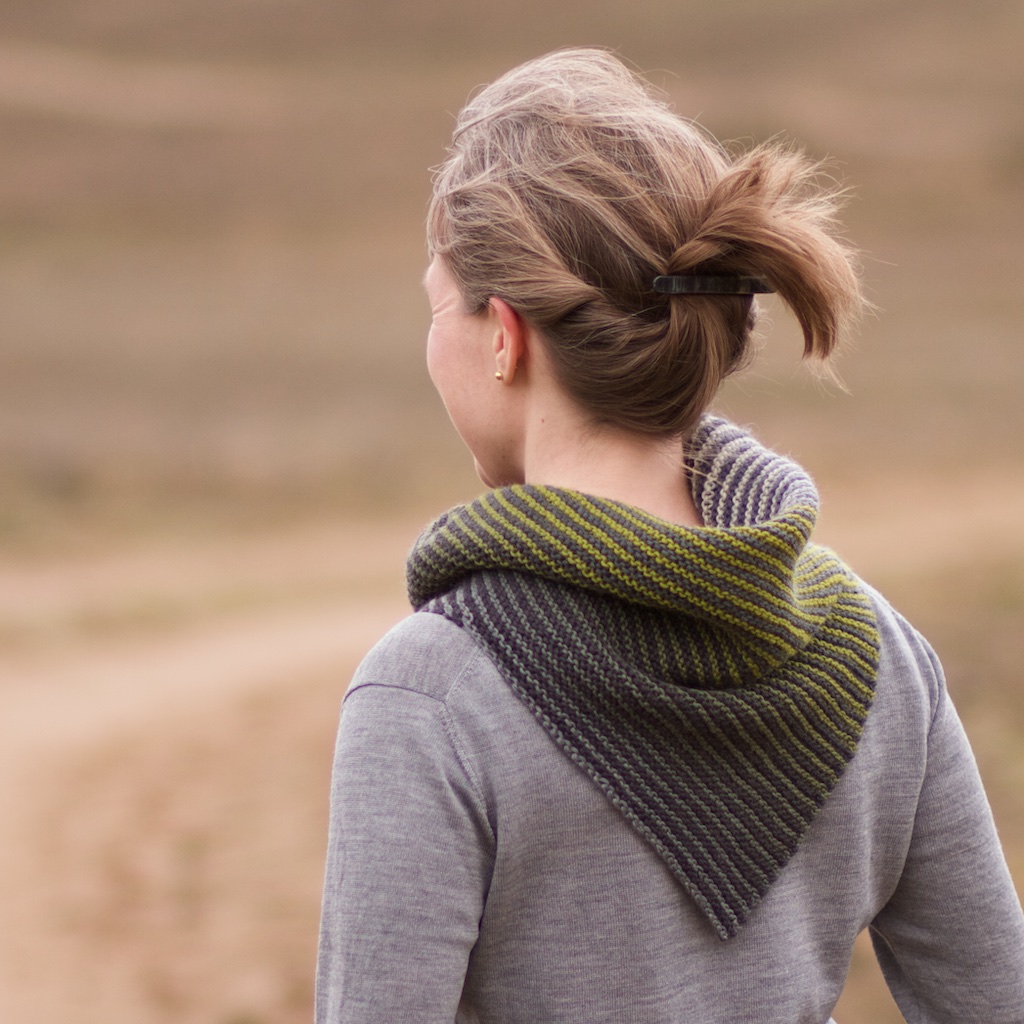
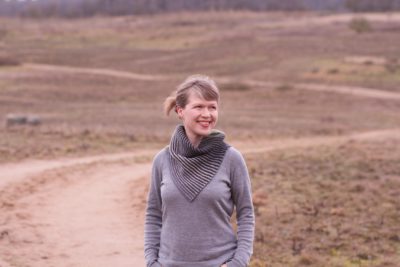
Garne mit Farbverlauf sind einfach faszinierend, und wenn man gleich zwei auf einmal verwendet, hat man doppelt so viel Spaß: Die ständigen Farbwechsel ergeben alle paar Reihen immer neue Streifenkombinationen. Dieser Cowl wird schräg gestrickt, und die clevere Konstruktion hält sowohl vorn als auch im Nacken angenehm warm.
Diese Anleitung wurde ursprünglich im Buch „Masterclass Stricken“ von Jen Arnall-Culliford veröffentlicht und war dazu gedacht, provisorische Anschläge und das Zusammenfügen im Maschenstich einzuüben. Meine Video-Tutorials zu diesen Themen findest du hier.
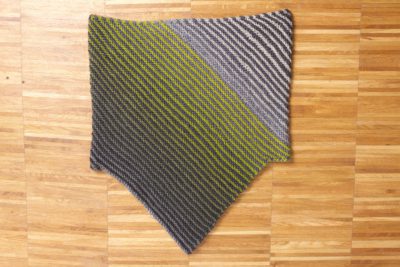
Die Anleitung gibt es auf Ravelry und im Strickmich! Shop zum download und gedruckt. Im Strickmich! Shop haben wir außerdem das Garn Schoppel Gradient in vielen schönen Farben vorrätig, sowie Kits in der Original-Farbzusammenstellung „Gelbfilter“ und „Schatten“.
Gradient yarns are fascinating, and the fun doubles when you use two of them together: The constant color changes will produce new interesting stripes every couple of rows. Knit on the bias in garter stitch, this cowl makes use of a clever construction, resulting in a useful shape that will keep the back of your neck and your front warm and cozy.
This pattern was originally published in Jen Arnall-Culliford’s book “A Year of Techniques” in the chapter teaching you how to do a provisional cast on and garter stitch grafting.
Find Jen’s tutorials about these techniques on her website: www.acknitwear.co.uk
The pattern is now available on Ravelry and in Strickmich! Shop as a download and printed version. In Strickmich! Shop we carry the beautiful yarn „Schoppel Gradient“ in lots of gorgeous colors, as well as kits in the color combination of the sample („Schatten“ and „Gelbfilter“).
Strickmich! Club 2019 Anstrick-Video No. 1Strickmich! Club 2019 Cast-on Video No. 1
Und hier ist es, das erste Anstrick-Video vom Strickmich! Club 2019. Viel Spaß!
Und nicht vergessen: Ab 12 Uhr sind wir live auf Youtube!
(Externe Links zu Vimeo.com und youtube.com)
Here it is: The first virtual cast-on event of Strickmich! Club 2019. Enjoy!
P. S.: And don’t forget to watch us live on youtube at 12 noon German time!
Links to external pages vimeo.com and youtube.com.
Mulesing muss nicht seinNo Mulesing, Please
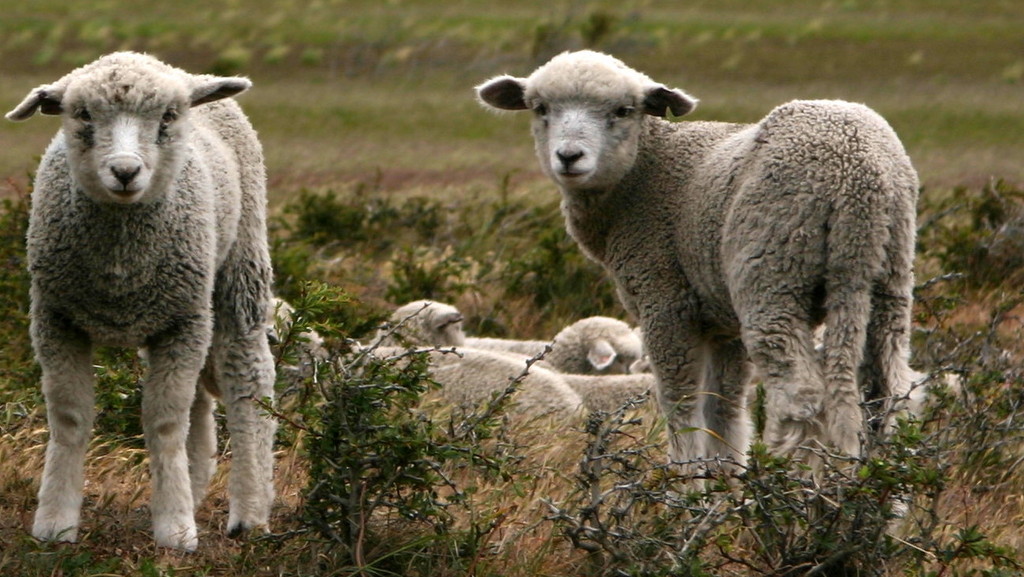
Patrick Gruban, Mit-Gründer und Mit-Inhaber von Rosy Green Wool, über Mulesing bei Merinoschafen und was Handstrickerinnen dagegen tun können
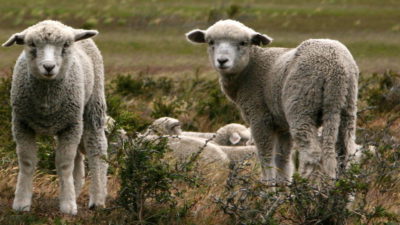
Merinolämmer
Martina Behm: Gerade gab es einen Artikel in DER SPIEGEL und eine ZDF-Reportage über Mulesing bei australischen Merino-Schafen: Dabei wird den Lämmern die Haut um den After herum ohne Betäubung abgeschnitten – eine Praktik, die Tierschützer schon lange kritisieren. Sind denn tatsächlich nur Merinos in Australien betroffen?
Patrick Gruban: Ja, denn die Merinoschafe sind dort extra so gezüchtet, dass sie möglichst viel Wolle produzieren: Sie haben sehr viel Hautfläche und sind darum sehr faltig. In den Falten können sich dann Fliegen niederlassen und Eier ablegen, aus denen Maden entstehen, besonders im Afterbereich. Andere Schafsrassen sind nicht betroffen.
Warum ist das nur in Australien ein Problem?
Die schädliche Fliegenart gibt es nur in Australien – in Südafrika und Südamerika kommt sie dagegen gar nicht vor. In Neuseeland gibt es Merino-Züchtungen mit weniger Hautfalten, und die werden nicht so stark befallen. Dort wurde das Mulesing letztes Jahr verboten, darauf hat man dort jahrelang mit Züchtungen und alternativen Methoden zur Schädlingsbekämpfung hingearbeitet. Wer in Neuseeland Mulesing durchführt, muss mit hohen Geldstrafen rechnen.

Wie kann man ohne Mulesing verhindern, dass Parasiten die Schafe befallen?
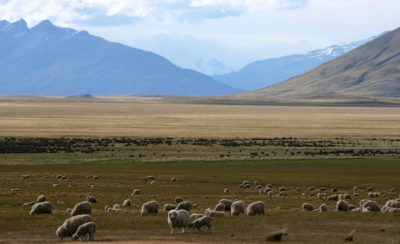
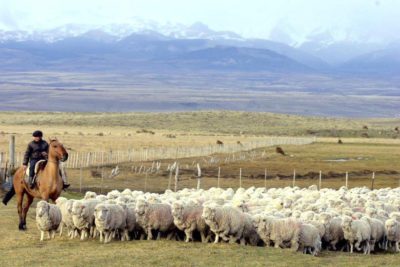
Wenn der Züchter immer nah an der Herde ist, die Tiere im Blick hat und sie kontrolliert, dann fällt ihm auf, wenn etwas nicht stimmt und er kann sie behandeln. In Australien sind die Herden sehr groß, laufen frei herum und werden nur per Helikopter beobachtet, und der Farmer sieht sie nur zweimal im Jahr zur Schur. Statt die Haut am Hintern der Tiere operativ zu entfernen, könnte man sie auch mehrmals im Jahr dort scheren, damit die Stelle sauber bleibt und weniger Fliegen anzieht – aber das wäre für australische Farmer aufwändiger und teurer als Mulesing, darum machen es nur wenige.
Aber Mulesing kann ja auch nicht verhindern, dass sich in den Falten am übrigen Körper Maden festsetzen…
Nein, das nicht. Aber dort, wo viel Wolle wächst, kommen die Fliegen nicht so leicht an die Haut heran. Darum ist es an den anderen Körperstellen nicht so ein großes Problem.
Wäre es ein Fortschritt, wenn die Schafe bei der Operation betäubt werden?
Es ist unklar, wie viel das bringt – während des Abheilungsprozesses, der mehrere Wochen dauert, wirkt die Betäubung ja nicht mehr. Aber es wäre natürlich ein Schritt in die richtige Richtung, zumal das Thema seit Jahren bekannt ist. Immer noch werden 70% aller Mulesing-Operationen ohne Betäubung durchgeführt – ein Skandal, den man nur mit der Profitgier der Farmer erklären kann. Der Preis für Merinowolle ist in den vergangenen Jahren um 50% gestiegen, da würde man auch noch genug daran verdienen, wenn man ein paar Cent für die Betäubung ausgibt.
Am einfachsten wäre ja, wenn die Australier ein Gesetz hätten, das das Mulesing verbietet…
Sicher, zumal man sich in Australien des Problems schon seit 15 Jahren bewusst ist. 2004 hatten sie beschlossen, das Mulesing bis 2010 komplett abzuschaffen, aber daraus ist nichts geworden. Es ist immer schwer, beim Thema Tierschutz etwas zu ändern – das sieht man in Deutschland, zum Beispiel beim Thema Ferkelkastration ohne Betäubung. Da dauert es auch wahnsinnig lange, bis neue Gesetze verabschiedet werden.
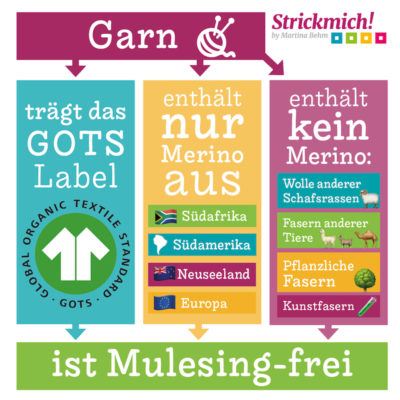
Wenn ich sichergehen möchte, dass mein Merinogarn ohne Mulesing produziert wurde, kann ich also zum Beispiel darauf achten, dass es aus Südafrika, Südamerika oder Neuseeland kommt…
Genau, aber das ist oft schwierig, weil die wenigsten Anbieter Angaben über die Herkunft des Garns oder die Schafsrasse machen können. Manche schreiben einfach „Wolle“ aufs Etikett und verschweigen, dass es sich um Merinowolle handelt, die von Mulesing betroffen sein könnte. Bei anderen ist die Lieferkette so lang und undurchsichtig, dass man gar nicht mehr sicher sagen kann, woher die Fasern kommen: Der Garnproduzent kauft bei der Spinnerei, die kauft beim Zwischenhändler, der vom Lieferanten und so weiter. Bei Handfärberinnen, die ihr Garn von Großhändlern beziehen, kommt noch ein Schritt dazwischen. Oft läuft das Ganze nur über Vertrauen: Der Hersteller oder Handfärber sagt, das Garn sei Mulesing-frei, kann es aber nicht nachweisen. Und da 90% der weltweiten Produktion von Merinofasern aus Australien kommt, braucht man schon einen besonderen Nachweis für die zusätzliche Sicherheit, dass sie eben nicht in einem Garn stecken. Darum haben wir schon ganz am Anfang gesagt: Wir brauchen für unser Garn ein Zertifikat, einen Beweis, dass es wirklich tierfreundlich produziert wird. Mit dem GOTS-Label –Global Organic Textile Standard – haben wir das. Und wir haben uns auch früh dafür entschieden, unsere Garne auch Handfärberinnen anzubieten.
Warum gehen so wenige Garnhersteller offensiv mit dem Thema Mulesing um? Es gibt ja einige, die nur Merinofasern aus Südamerika oder Südafrika verwenden…
Wer sich zu Mulesing-freier Wolle bekennt, legt sich fest und ist dann unflexibel, wenn Lieferengpässe bei auftreten. Weil wir nicht auf andere Quellen ausweichen können, sind wir gezwungen, langfristige Verträge mit den Lieferanten zu machen und schon zuzusagen, welche Mengen wir in den kommenden Jahren abnehmen werden. Das ist ein Risiko. Bei uns kommt noch hinzu, dass wir als einzige Garnmarke der Welt nur GOTS-zertifizierte Garne anbieten – damit schränken wir uns stark ein, weil wir zum Beispiel Fasern wie Kaschmir oder Seide nur schwer oder gar nicht in dieser Qualität bekommen.
Sind Handstrickerinnen sensibler für das Thema Mulesing als Leute, die ihre Mode fertig kaufen?
Ja, insbesondere die, die sich für hochwertige Garne interessieren. Meine Schätzungen ergeben aber, dass immer noch mindestens 99,5% der in Deutschland verkauften Handstrickgarne nicht GOTS-zertifiziert sind. Klar gibt es auch Hersteller, die zwar kein Zertifikat haben, aber durch eine kurze Lieferkette oder weil sie die Herkunftsfarmen kennen, Mulesing-freies Merinogarn anbieten und damit im grünen Bereich sind – aber letztendlich fehlt doch die Transparenz.
Wie hat sich die Einstellung von Strickerinnen geändert, seit ihr 2012 mit Rosy Green Wool gestartet seid?
Das Thema Mulesing kommt etwa alle fünf Jahre wieder hoch, aber es wird immer noch zu wenig darüber gesprochen. Wir hören ganz oft, dass Leute erst durch unsere Garne überhaupt vom Mulesing erfahren haben und sich dann vornehmen, beim Einkauf mehr darauf zu achten, dass das Garn zertifiziert ist – das ist für uns natürlich das schönste Kompliment!
GOTS
Global Organic Textile Standard – das strengste Label für ökologisch und sozial einwandfrei hergestellte Textilien. Bei Garnen und Kleidung mit dem GOTS-Label kann man sicher sein, dass…
• die Tiere kontrolliert biologisch gehalten werden, kein Mulesing und keine Pestizide verwendet werden
• faire Arbeitsbedingungen herrschen und keine Kinderarbeit stattfindet
• keine umwelt- und gesundheitsschädlichen Chemikalien verwendet werden
• Abwässer fachgerecht entsorgt und der Energieverbrauch kontrolliert wird
• kein chemischer Mottenschutz zum Einsatz kommt.
Mehr Info auf www.global-standard.org
Rosy Green Wool
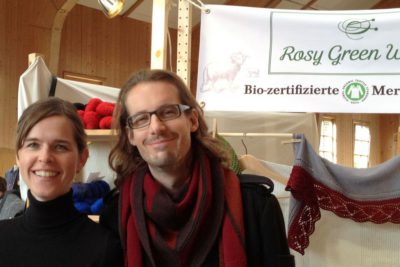
Wurde 2012 von Rosmary Stegmann und Patrick Gruban in München gegründet und brachte das erste GOTS-zertifizierte maschinenwaschbare Merinogarn auf den deutschen Markt. Rosy Green Wool ist der weltweit einzige Hersteller, der nur GOTS-zertifizierte Handstrickgarne anbietet.
Diese Garne im Strickmich! Shop sind Mulesing-frei:
Blacker Yarns (Merinofasern von den Falkland-Inseln plus Shetlandwolle)
Schoppel (Merino aus Patagonien)
Something to Knit With (Hochlandwolle aus Peru + Alpaka)
Rosy Green Wool (GOTS-zertifizierte Garne mit Merinofasern aus Argentinien)
Amano (Alpakagarne)
Cowgirlblues (Merinofasern aus Südafrika)
Fino von Manos del Uruguay (Merinofasern aus Südamerika)
Yummy 2ply und Yowza von Miss Babs (Merinofasern aus Südafrika)
Yakusi (Yak-Fasern mit Seide)
Fotos © Rosy Green Wool
Patrick Gruban, co-founder and co-owner of German organic yarn pioneer Rosy Green Wool talks about mulesing of Merino sheep, and what knitters can do about this
Merino lambs
Strickmich!: In Germany, reports about mulesing in Australian Merino sheep are in the news right now: The sheep’s skin around the buttocks is cut off without any painkillers. The practice has been widely criticized for a long time. Are only Merino sheep in Australia affected?
Patrick Gruban: Yes, Merino sheep are bred specifically to yield the maximum amount of fiber, so they have lots of skin and many skin folds. Into those folds, flies can place their eggs and maggots emerge, especially in the buttock area – this is called “flystrike”. Mulesing is not used in other sheep breeds.
Why is it only common in Australia?
The fly species that harms sheep only exists in Australia and New Zealand. Sheep in South Africa and South America won’t be affected. In New Zealand, farmers have made an effort to breed Merino sheep with fewer skin folds, so the problem of flystrike is not as pronounced there. New Zealand has also developed other methods to combat the flies, and last year they passed a law that prohibits mulesing entirely and sanctions it with heavy fines.
What are alternative methods to prevent flystrike?
If the farmer monitors his flock closely and checks on his sheep regularly, he will notice if anything is wrong and can take action. In Australia, flocks tend to be very large, they roam freely, and are often only monitored by helicopter. The farmer usually sees his sheep twice a year for shearing. Instead of cutting off the sheep’s skin, one could simply shear the area around the buttocks several times a year, so it would stay cleaner and attract fewer flies – but that would be a lot of work, and very expensive for Australian farmers, so only very few do it.
Patrick Gruban
Mulesing also won’t prevent the flies from laying their eggs on other parts of the sheep’s body…
No, but if there is a lot of wool growing on the skin, flies won’t find it so easy to reach the skin to lay their eggs. So it’s not such a big problem in other areas.
Would you consider if progress if anesthetics were used during the mulesing surgery?
It’s not clear how much that would help – the sheep would certainly feel pain until the wounds are healed, which can take several weeks. But it would certainly be a step in the right direction, especially as the problem has been known for years. 70% of all mulesing still happens without painkillers – in my view, that’s outrageous, and can only be explained by farmers’ focus on profits and their greediness. The price for Merino fiber has gone up by 50% during the past years, so they would still earn enough if they were to spend a small amount on anesthetics.
The Australian government could simply pass a law that forbids mulesing…
Sure, especially as Australian sheep farmers have been aware of the problem for more than 15 years. In 2004, there was an initiative to get rid of mulesing until 2010, but that date has passed and nothing has happened. It is always hard to change things when it comes to animal welfare – we see that now in Germany, where the government is trying to pass a law against neutering pigs without painkillers. It takes forever to reach a consensus.
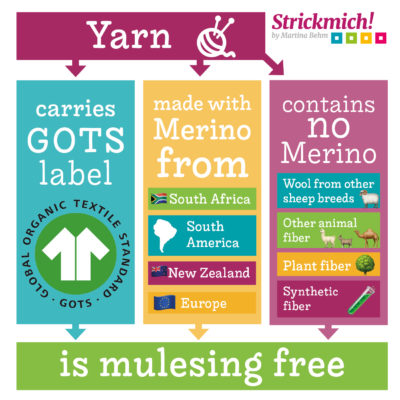
So, if I wanted to buy Merino yarn that was made without mulesing, I could just make sure that the fiber comes from South America, South Africa or New Zealand?
Yes, but that can be difficult, as very few brands can give detailed information about the origins of the fiber or even the sheep breed they used. Some just put “wool” on their label and won’t tell you it is Merino that could be affected by mulesing. Sometimes the supply chain is so long and obscure that it is impossible to tell where the fiber came from: The yarn brand buys from the spinning mill, the spinning mill from a fiber wholesaler, the wholesaler from the producer and so forth. With hand dyers who buy their yarn from a yarn wholesaler, there is an additional step involved. The whole chain relies on trust: The yarn brand or dyer says the yarn is mulesing-free, but cannot really prove it. However, 90% of all Merino fiber worldwide is from Australia, so you need additional proof that they are not part of the yarn you are buying. That’s why we decided right from the beginning that we needed the GOTS certificate – Global Organic Textile Standard. We are also aware how hard it is for hand dyers to find certified yarn bases, so we decided to offer our yarn to them, too.
Why are yarn brands so shy about the topic? There are several around that have been using only Merino fiber from South America or South Africa for years…
If you make a statement like “our yarn is mulesing-free” you kind of lock yourself in, and become less flexible in case of a shortage. At Rosy Green Wool, we cannot use other sources for our Merino fiber and have to make long-term contracts with the suppliers from South America, stating how much we will buy in the upcoming years. That’s quite a risk. For us, it’s even harder as we are the only yarn brand in the world that offers only GOTS-certified yarns, so we cannot use cashmere or silk in our yarns as they are very hard to come by in that quality.
Are hand knitters more aware of mulesing than consumers who buy ready-made clothes?
Yes, especially those who are interested in high-quality hand knitting yarns. But according to my estimates, more than 99.5% of all knitting yarns sold in Germany are still not GOTS-certified. A couple of yarn brands might be in the clear without a certificate because they have a short supply chain, or personally know the farmers providing their wool, and offer mulesing-free Merino – but in the end, they lack the transparency that only a label can provide.
Has the attitude of handknitters towards animal welfare changed since you started out with Rosy Green Wool in 2012?
Mulesing as a discussion point comes up roughly every five years, but I think that’s not enough. We often hear from people who say they became aware of the problem through our yarn, and that they decided to pay more attention to whether a yarn is certified or not in the future – that’s a huge compliment for us!
GOTS
The Global Organic Textile Standard is the strictest label for textiles produced environmentally friendly, socially conscious and animal friendly. If you buy clothes or yarn carrying the GOTS label, you can be sure that…
• the animals were raised according to high welfare standards, no mulesing took place, and no pesticides were used
• that fair working conditions apply, and no child work was involved
• no chemicals that might harm the environment or human health were used
• waste water is professionally treated, energy use is controlled
• no chemical moth-repellants were used.
More on www.global-standard.org
Rosy Green Wool
Was started in 2012 by Rosmary Stegmann and Patrick Gruban in Munich, and launched Germany’s first GOTS-certified machine-washable Merino yarn for hand knitters. Rosy Green Wool is the only yarn brand in the world that offers only GOTS-certified yarns.
These Yarns in Strickmich! Shop are mulesing-free:
Blacker Yarns (Merino from the Falkland Islands plus Shetland wool)
Schoppel (Merino fiber from Patagonia)
Something to Knit With (Highland Wool from Peru + Alpaca)
Rosy Green Wool (GOTS-certified yarns with Merino fiber from Argentina)
Amano (Alpaca yarns)
Cowgirlblues (Merino fiber from South Africa plus Mohair)
Fino by Manos del Uruguay (Merino fiber from South America)
Yummy 2ply and Yowza by Miss Babs (Merino fiber from South Africa)
Yakusi (Yak Fiber plus Silk )
Fotos © Rosy Green Wool
Wir sind auf der H+H!Come see us at H+H Cologne!
Das wird aufregend! Nachdem wir in den vergangenen Jahren immer nur Gäste auf der H+H waren, werden wir in diesem Jahr Aussteller – mit dem wahrscheinlich winzigsten Messestand der Welt, gleich neben Strickmicki in Halle 2.2, Stand F29. Peter und ich sind da, ich bringe meine Tücher und gedruckten Anleitungen mit, außerdem gibt’s den Strickplaner live und in Farbe zu bestaunen und die schönen Strick-Accessoires von Lazadas. Die H+H findet in Köln vom 29. bis zum 31. März statt, und wir freuen uns über jede Strickerin, Bloggerin und Wollgeschäftsinhaberin (Männer dürfen sich mitgemeint fühlen), die bei uns vorbeischaut. Wir sehen uns!
During the past years, we have only been visitors at H+H – but this year we will exhibit, probably with the smallest booth this trade show as ever seen. We’re next to Strickimicki in Halle 2.2, Stand F29. Peter and I will both be manning our booth, we will bring my printed patterns and my knitted samples, Strickplaner and the beautiful knitting accessories by Lazadas. H+H Cologne is open from March 29th to 31st, and we will be happy to welcome knitters, bloggers and LYS owners at our little booth :) See you there!
Big & Beautiful
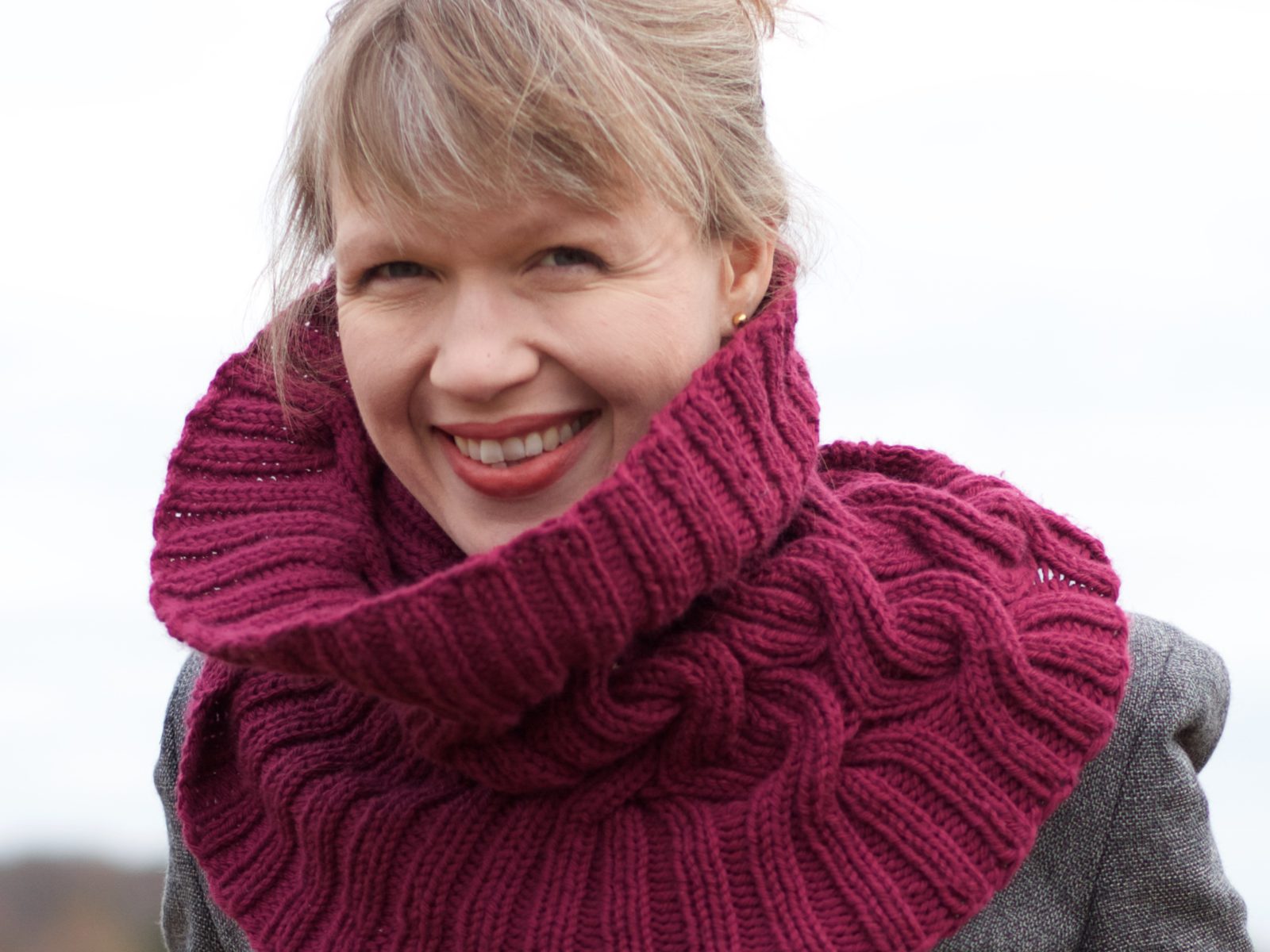
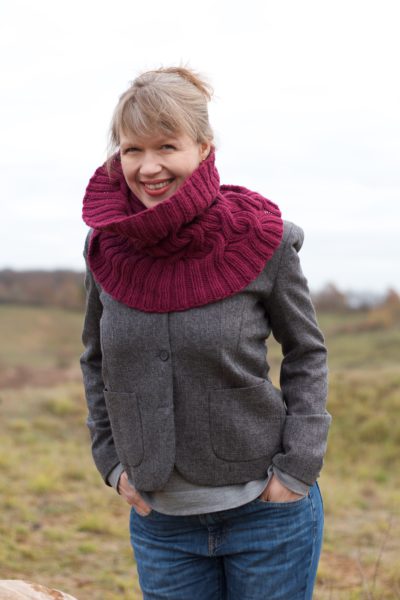
Seit knapp fünf Jahren wohne ich in einem alten Gasthof in Schleswig-Holstein, gebaut 1906, renoviert in den späten 80ern. Es ist wunderschön hier, und ich liebe dieses Haus, aber es ist so groß (ausreichend für zünftige Stricktreffen!), dass wir immer nur die Räume heizen können, die wir auch benutzen. Der Holzofen tut sein bestes, und doch sitze ich im Winter mit drei Lagen Wolle an meinem Schreibtisch, und etwas Kuscheliges um den Hals muss auch sein.
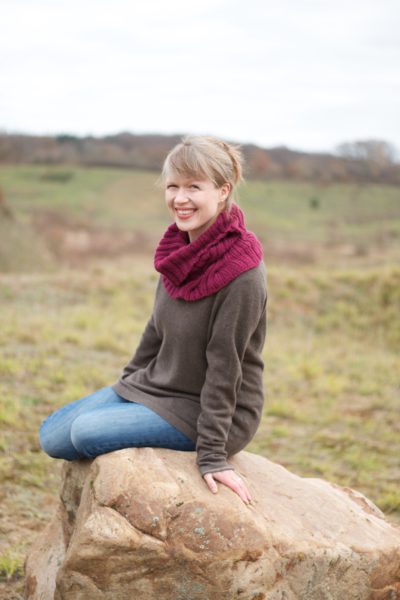
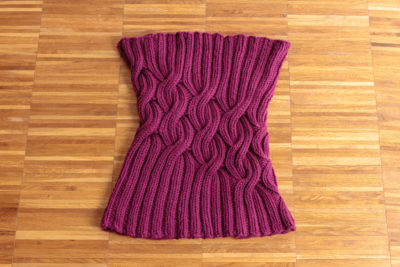
Dieser große, schöne Cowl aus dem tier- und umweltfreundlichen Garn „Big Merino Hug“ von Rosy Green Wool ist mein neues Lieblingsteil: Die Zöpfe sehen von beiden Seiten schön aus und winden sich spiralig rundherum, so dass an den Schultern etwas mehr Weite entsteht als am Hals. Ob hoch- oder umgeschlagen, ob innen oder außen: Einfach groß, kuschelig und schön – Big & Beautiful!
Das wunderschöne Garn „Big Merino Hug“ von Rosy Green Wool führen wir in vielen schönen Farben im Strickmich! Shop, und wir bieten auch Kits mit der Anleitung und dem Garn an.
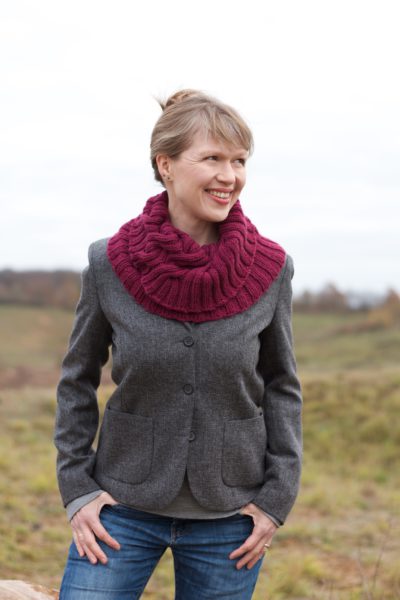
I have been living in an old pub in the northern German countryside for five years now. It was built in 1906 and remodeled in the late 1980s. It’s beautiful and I really love it, but the house is quite big (big enough to hold knitting events and classes!), so we only turn on the heating in the rooms we actually use – plus the wood stove, of course.
When I am sitting at my desk, I usually wear three layers of wool plus something cozy around my neck, and this big and beautiful cowl out of the soft and eco-conscious Aran-weight yarn „Big Merino Hug“ by Munich based yarn company Rosy Green Wool is my new favorite: The reversible cables spiral elegantly around it, so it’s a little wider at the shoulders and narrower around your neck. Up or down, inside or out: just big and beautiful!
The amazingly soft organic yarn „Big Merino Hug“ is available in Strickmich! Shop in 13 great colors, and we also carry kits. Shipping is worldwide!
Azubi gesucht!We’re hiring!
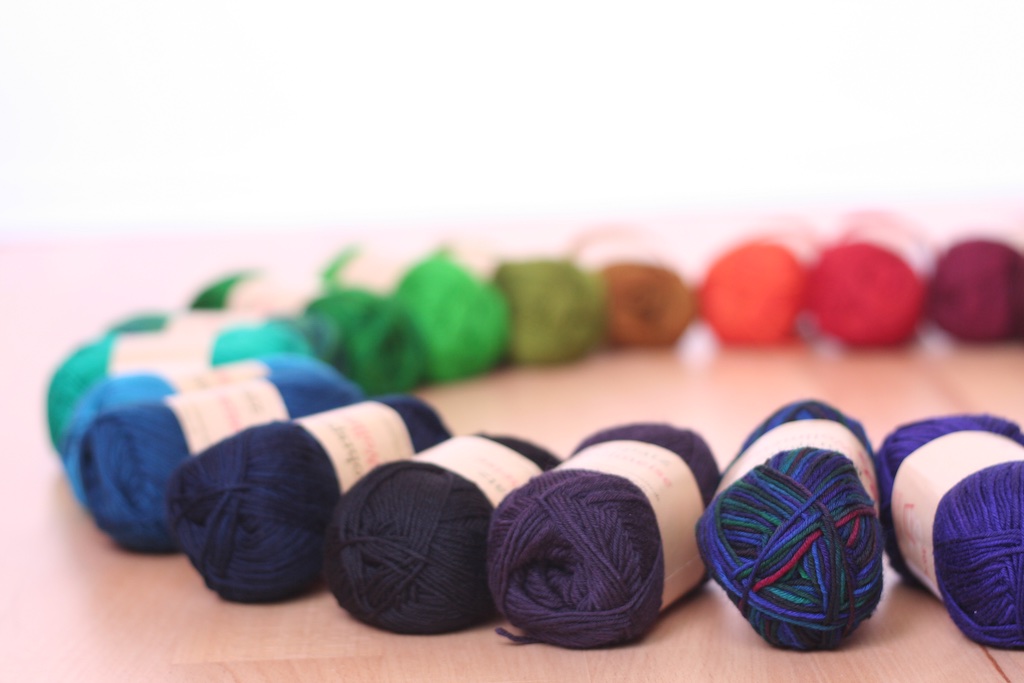

Wir haben viel zu tun noch noch viel vor – darum bieten wir ab 1. August 2019 eine Stelle als
Auszubildende/r zur/zum Kauffrau/-mann im E-Commerce (w/m/d)
Die Ausbildung dauert 3 Jahre (ggf. Verkürzung möglich) und bereitet Dich ideal auf die Jobs von morgen vor.
Was Du lernst:
- Alles was im E-Commerce wichtig ist: vom Einkauf über die Produktpräsentation im Shop bis zur Auslieferung und Auswertung des Erfolges
- Verschiedene Online-Shops zu betreuen und weiter zu entwickeln
- Erfolgreiche Online-Marketing-Strategien zu entwickeln
- Mit Kunden per Email, Newsletter, Social Media oder Telefon zu kommunizieren
- Kaufmännisches Verständnis und Start-up Erfolgskriterien
Was Du mitbringst:
- (Fach-) Hochschulreife oder mittlerer Bildungsabschluss
- Sehr gutes Zahlenverständnis und sicherer Umgang mit dem Computer
- Sehr gute Deutsch- und Englischkenntnisse
- Spaß an Kundenkommunikation und Social Media
- Sympathie für kreative Hobbys und Handarbeiten, insbesondere Stricken
- Einen Sinn für Ästhetik und Design
- Die Begeisterung ständig Neues zu lernen und aktiv mitzugestalten
Was Du bekommst:
- Eine Ausbildung in einem zukunftsorientierten Beruf mit vielen Perspektiven
- Abwechslungsreiche und verantwortungsvolle Aufgaben
- Eine wichtige Rolle in einem erfahrenen Online-Team
- Ein persönliches und kreatives Arbeitsumfeld
Wer wir sind:
- Seit mehr als 5 Jahren ein kleines, erfolgreich wachsendes E-Commerce-Unternehmen
- Online Händler für Strickanleitungen, Garne und Zubehör mit weltweitem Versand
- Strickdesignerin Martina Behm als kreativer Kopf der Unternehmung
Du möchtest unser weiteres Wachstum mitgestalten? Dann freuen wir uns über Deine PDF- Bewerbung per Email an Peter Steck: bewerbung@strickmich.deStrickmich! e.K. • Dorfstr. 2g • 23824 Damsdorf • Tel: 04323 4029 642
Email: bewerbung@strickmich.de
http://www.strickmich.de • https://strickmich-shop.de • https://strickmich-club.de
Die Stellenanzeige kannst du hier als PDF downloaden.
Strickmich! is looking for a (German and English speaking) trainee – please find our job description here.
Strider
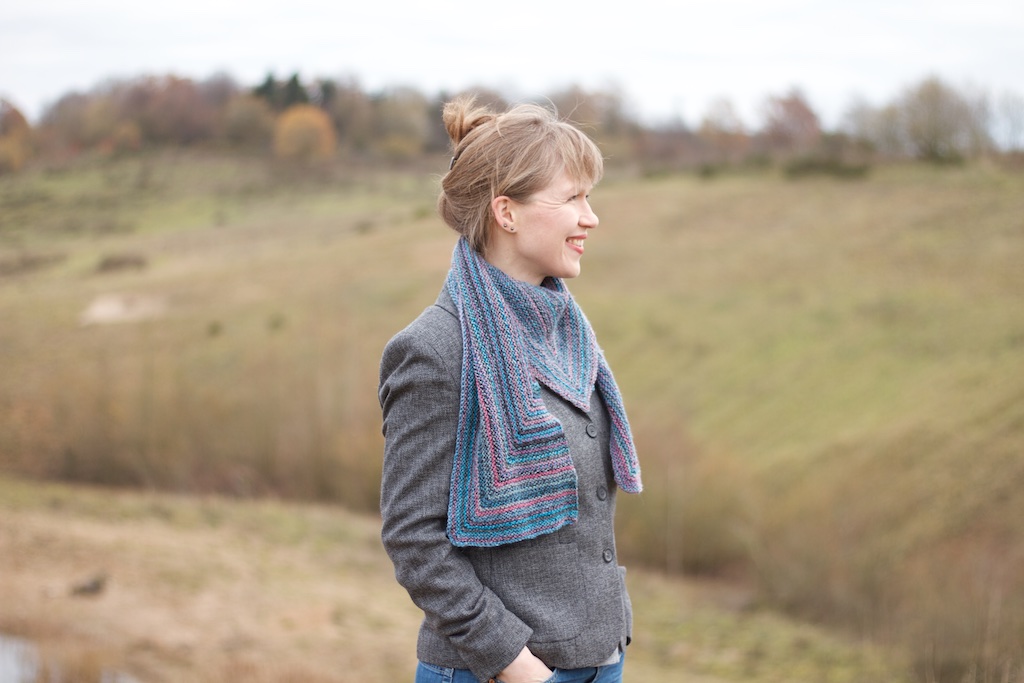
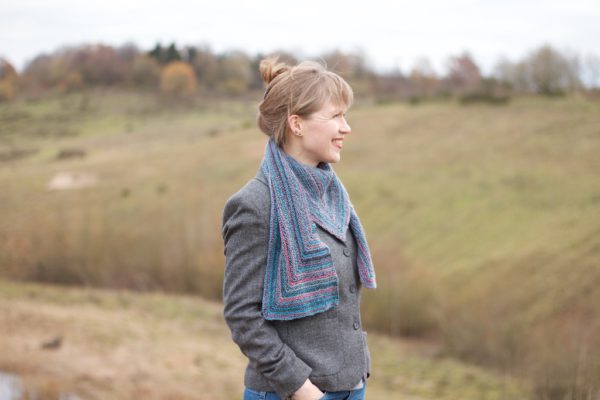
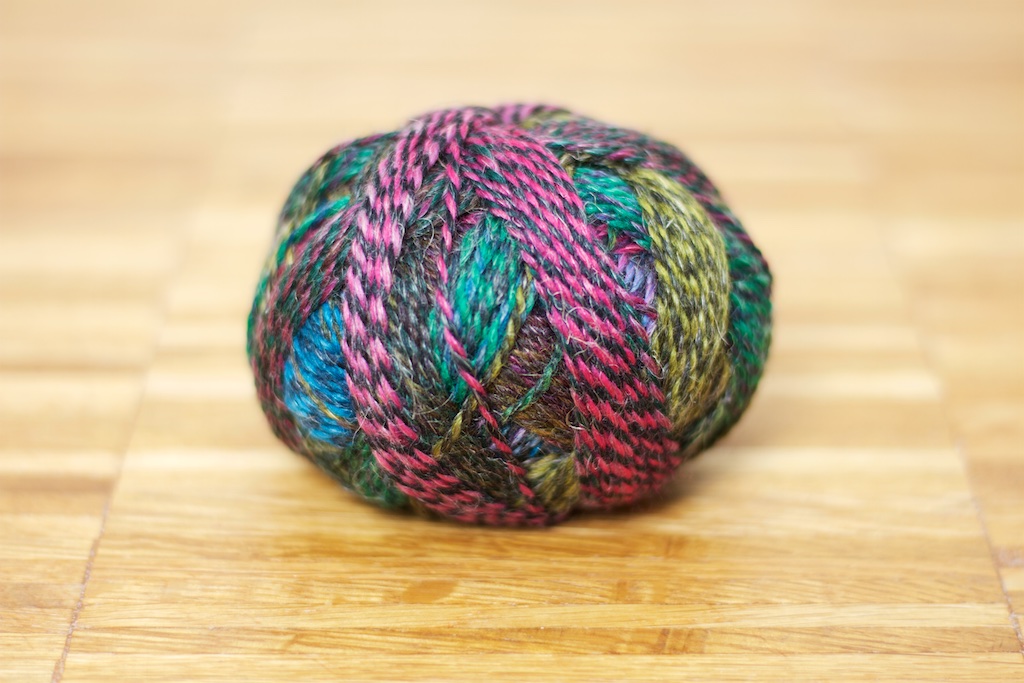
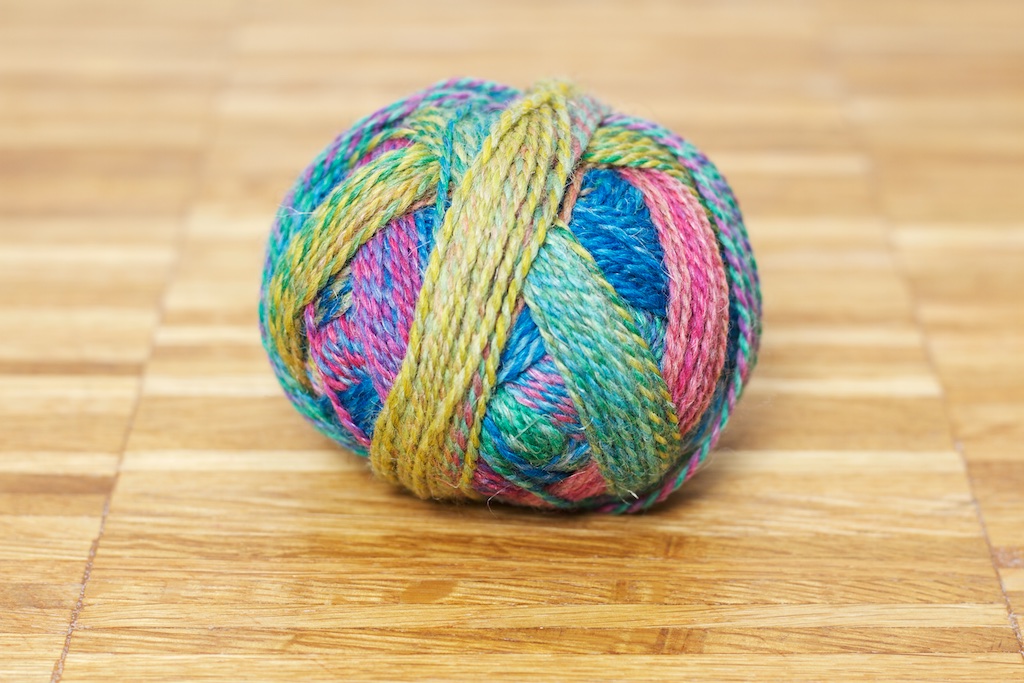
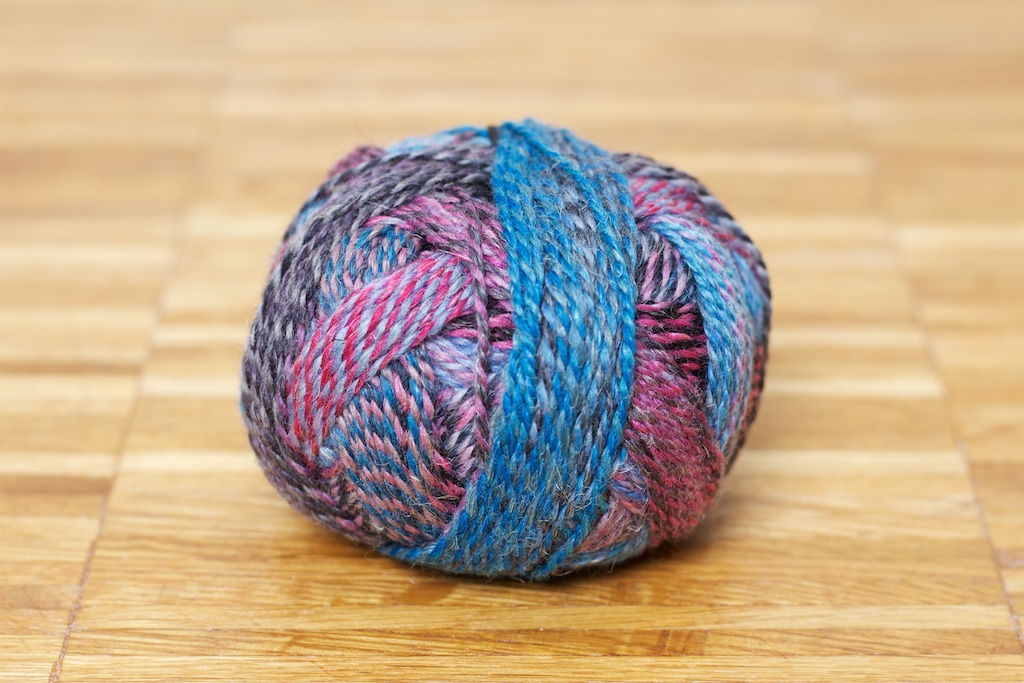
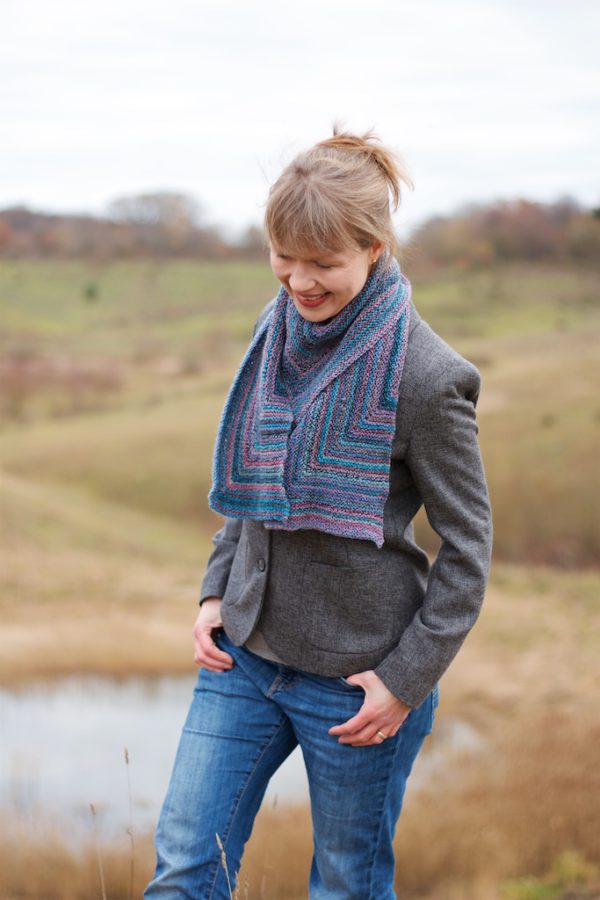
Durchatmen, weit gucken, ein paar Kilometer gehen in einer bizarren Landschaft, die der Kiesabbau rund um unser Dorf hinterlassen hat – das brauche und genieße ich jeden Tag. „Strider“ ist ein Schal, der mir dabei gute Dienste leistet: In der Mitte ist er geformt wie ein Dreieckstuch, die Enden sind eckig wie bei einem Schal. Die geometrische Konstruktion kommt in einem Garn mit Farbverlauf schön zur Geltung.
 |
 |
 |
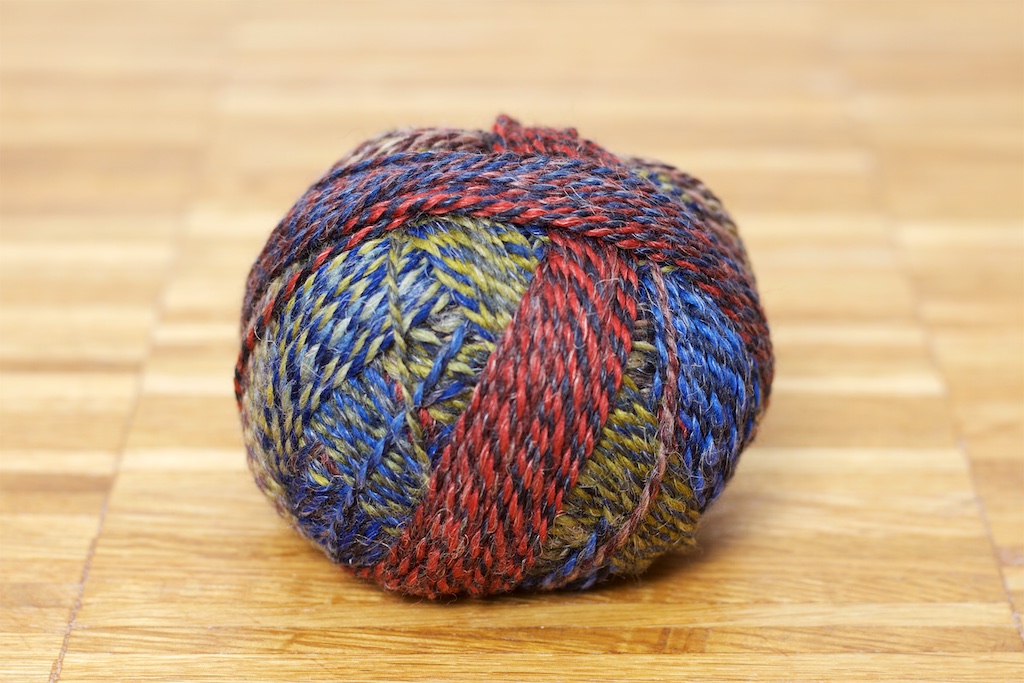 |
Gestrickt wird kraus-rechts, und die Anleitung ist so einfach und kurz, dass sie perfekt für Strick-Einsteigerinnen geeignet ist. Mit mehr Garn lässt sich „Strider“ außerdem beliebig vergrößern. Das Garn „Edition 3 Hanf“ wurde von Schoppel für uns in vier exklusiven Farbverläufen für uns gesponnen und ist nur im Strickmich! Shop erhältlich.
Im Strickmich! Shop haben wir außerdem Kits aus dem Garn, der gedruckten Anleitung, Maschenmarkierern und dem Strickmich! Webetikett zu einem strickerinnenfreundlichen Preis zusammengestellt.
Take a deep breath, enjoy the view, walk a few miles in a bizarre landscape that was left behind by the gravel mines surrounding our village – that’s what I enjoy every day. “Strider” is a scarf that has proven immensely useful during my walks: In the middle, it is pointy as a shawl for extra warmth on the chest, but the ends are square. This fun geometric construction is accentuated by a pretty color-changing yarn. Entirely knit in garter stitch with super simple and short instructions, it is perfectly suited for a beginning knitter. Bonus: You can make this bigger by using more yarn – just knit until everything is used up.
|
|
|
|
The yarn “Edition 3 Hanf” was spun for us in 4 exclusive colorways by Zauberball maker Schoppel and is only available at Strickmich! Shop.
In Strickmich! Shop we also carry kits with 3 balls of the yarn (sufficient to make the scarf in the size shown in the pictures), the printed pattern, stitch markers and a Strickmich! fabric tag at a knitter-friendly price.
Horizonte
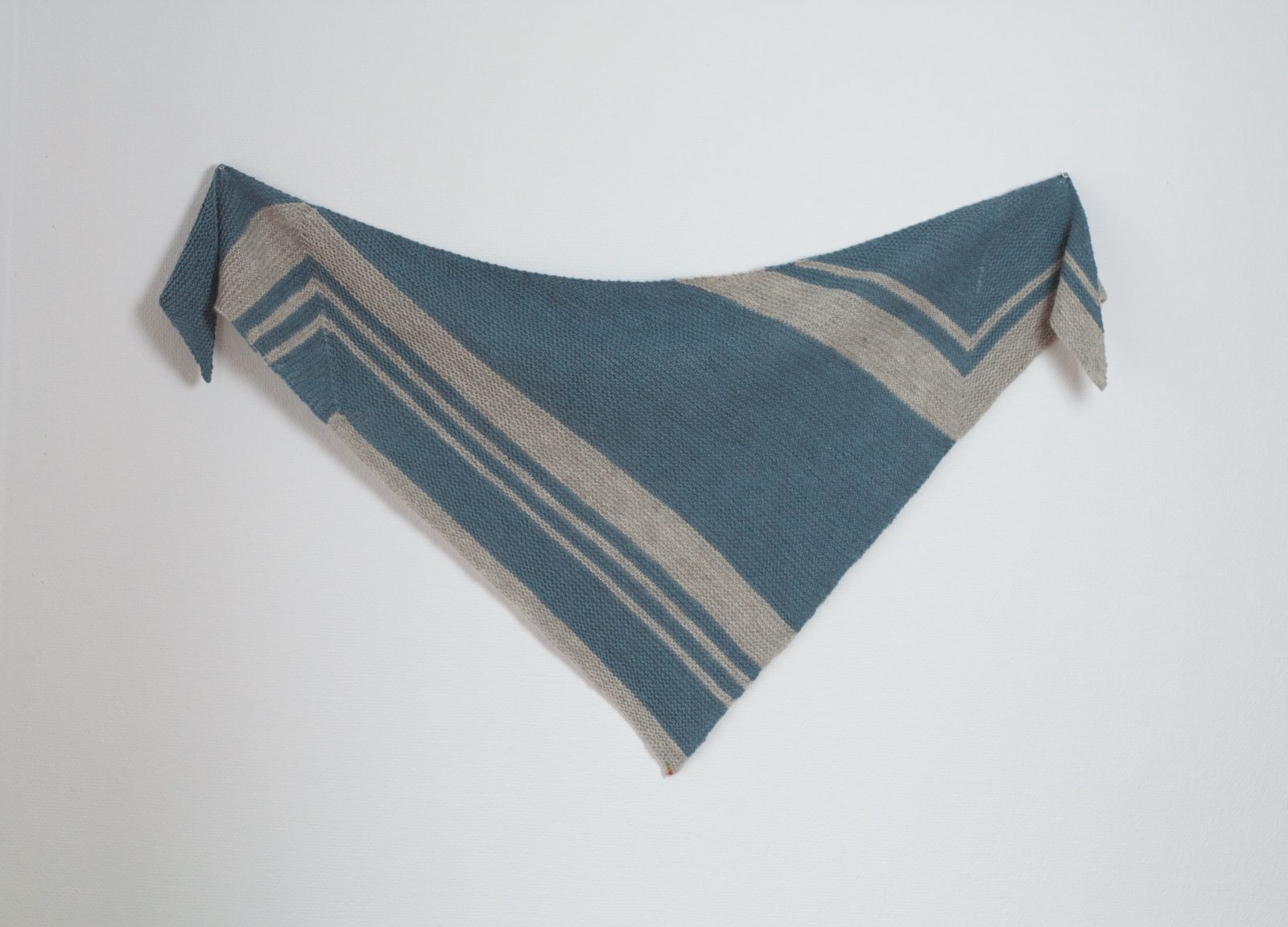
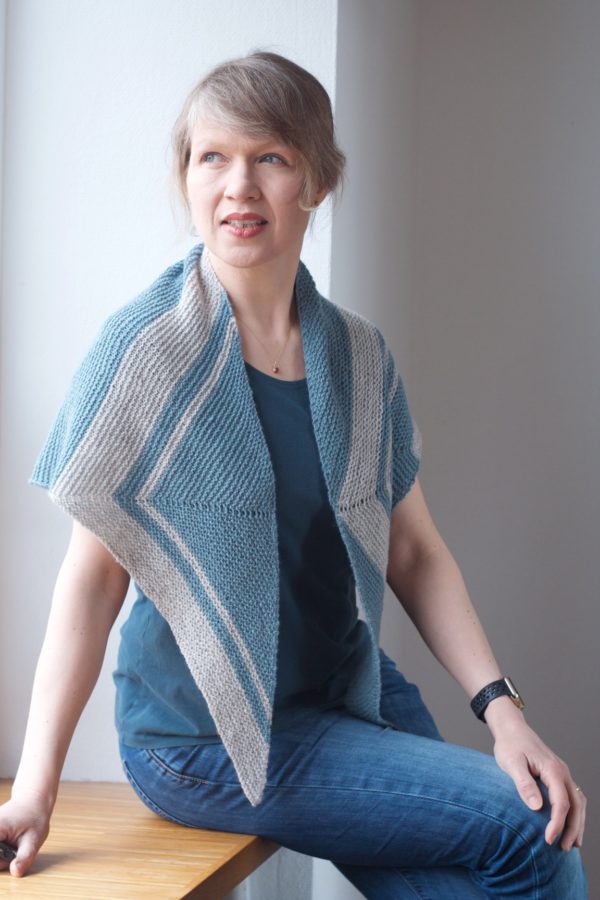
„Horizonte“ heißt dieses Tuch, das ich für die zweite Lieferung des Strickmich! Club 2018 entworfen habe. Denn genau wie der Blick auf den Horizont vermitteln Garn, Farbe und das Stricken selbst bei diesem Tuch Ruhe, Gelassenheit – „Frieden im Kopf“. Selbst wenn das Leben laut und kompliziert ist, bringt mich der weite Blick, den wir hier in Schleswig-Holstein genießen können, immer schnell wieder zurück zum Wesentlichen.
Horizonte ist ganz in kraus-rechts gestrickt, und mit der interessanten Konstruktion ist das Stricken zwar äußerst entspannt, aber keinesfalls langweilig. Das Garn „Blacker Swan 4-ply“ ist aus ultraweichen Merinofasern von den Falkland-Inseln mit einem geringen Anteil farbiger Shetlandwolle gesponnen, so dass sich eine schöne, natürliche, leichte Melierung ergibt. Im Strickmich! Shop haben wir noch einige wenige Kits in der Farbkombination vorrätig, die Sue Blacker extra für den Club hat färben lassen: 100 g „Horizon Blue“ und 50 g „Pale Maiden“. Natürlich kann man das Tuch auch aus anderen Farben stricken (die wir ebenfalls im Strickmich! Shop führen), dann benötigt man zwei 50-g-Knäule in der Haupt- und 1 Knäul in der Kontrastfarbe bzw. mehr, wenn man das Tuch größer arbeiten möchte.
Die Anleitung gibt es ab sofort auf Ravelry und im Strickmich! Shop (gedruckt oder als Download).
„Horizonte“ (German: „Horizons“) is the name of this shawl that I designed for the second instalment of Strickmich! Club 2018. Just as looking at the horizon will calm your nerves and put things into perspective, this combination of yarn, color and simple to knit pattern will feel soothing and relaxing. I feel that this is just what you need when life is loud and complicated.
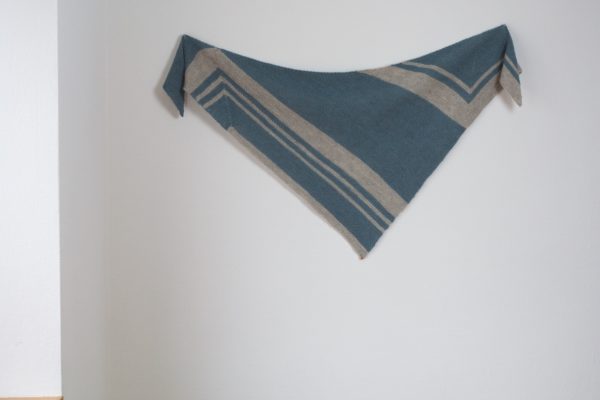
Horizonte is knit entirely in garter stitch, so it’s a very relaxing knit, but the construction with its different parts will keep you interested. The yarn „Blacker Swan 4-ply“ is spun out of ultrasoft Merino fiber from the Falkland Islands combined with a small amount of colored Shetland wool, resulting in a beautiful heathered effect. In Strickmich! Shop we do have a limited number of kits with the yarn Sue Blacker had dyed exclusively for Strickmich! Club. And if you would rather choose your own colors, we do carry „Blacker Swan“ in a range of beautiful alternatives. You will need 100 g (2 balls) of the main color plus 50 g (1 ball) of the contrast color (more if you wish to make your shawl larger). The pattern is available on Ravelry and in Strickmich! Shop (printed and as a download).
Pimp your Strickplaner – Giveaway!
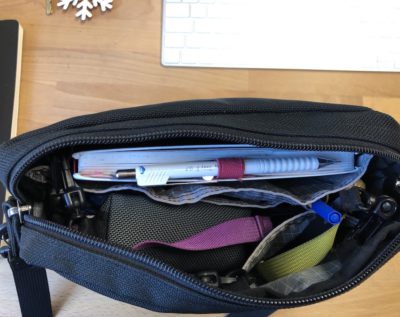
Nur noch wenige Wochen, dann wird der Strickplaner 2019 mein ständiger Begleiter sein – ich trage meinen Planer nämlich immer in meiner kleinen Umhängetasche (Side Kick von Tom Bihn) mit mir herum. Das hat den Vorteil, dass ich alle Infos über Termine und meine Strickprojekte immer griffbereit habe, und falls mir irgendetwas einfällt, das festgehalten werden muss, bin ich auch gerüstet.
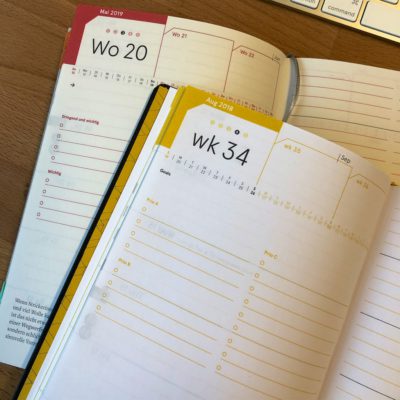
Den Strickplaner haben wir nun schon im zweiten Jahr gemeinsam mit den Kalenderprofis von weekview gestaltet: Das Kalendarium und Layout ist in etwa das gleiche wie beim weekview Compact Note. Links To-Do Listen (nach Prioritäten geordnet), rechts die Wochentage mit Platz für Termine. Ein paar wichtige Details sind anders: die Farben, die Strick-Inspiration unten links, die Überschriften für die To-Do-Liste, und bei uns gibt es statt „Zielen“ einfach einen Pfeil nach rechts. Hier ist dann Platz für Ziele, ein Wochenmotto oder andere Dinge, die in der Woche eben passieren (Schulferien, Strick-Event, Kieler Woche…).
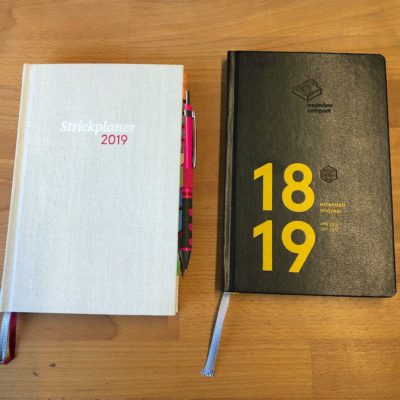
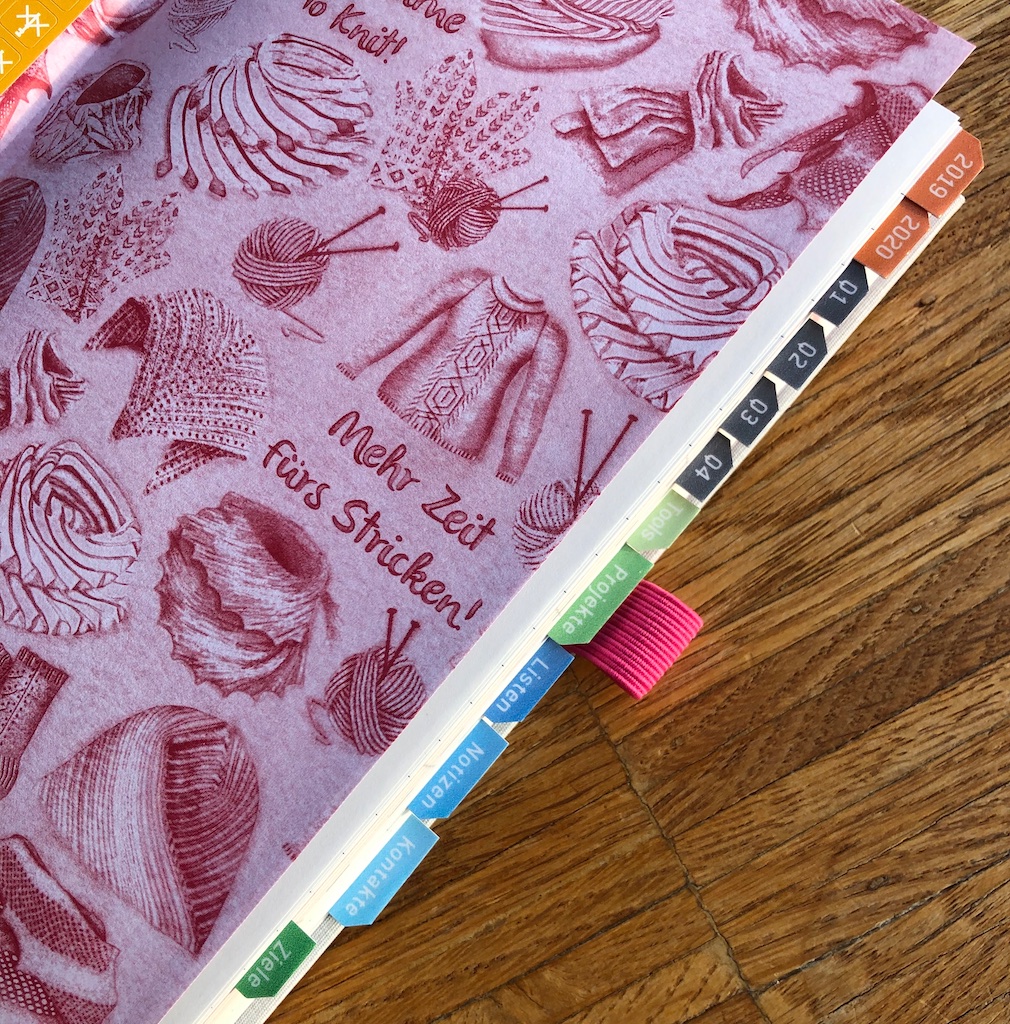
Das handliche Format ist beiden Kalendern gemein – und das hat den Vorteil, dass sämtliche Kalender-Accessoires, die weekview für den Compact Note anbietet, eben auch für den Strickplaner passen! Schon im (fast) vergangenen Jahr habe ich die einklebbaren Tabs genutzt – das ist so eine Art Register, mit denen ich mich in meinem Strickplaner besser zurecht finde.
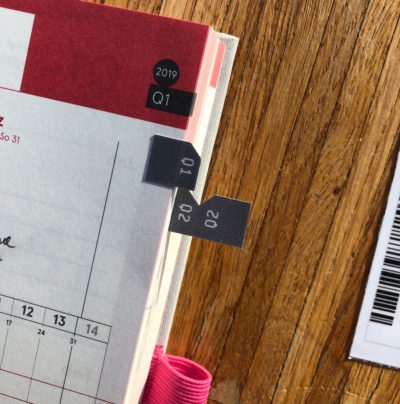
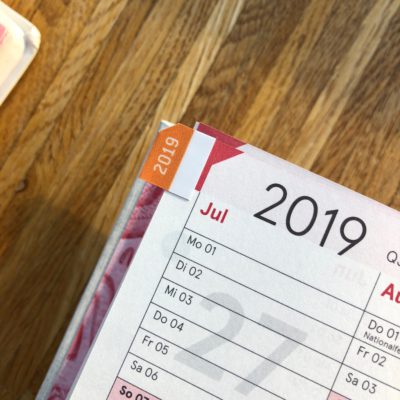
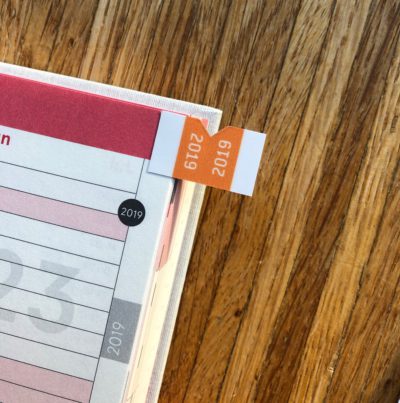
Also habe ich auch meinen Strickplaner 2019 mit den Tabs „gepimpt“ und bin sehr happy mit dem Ergebnis:
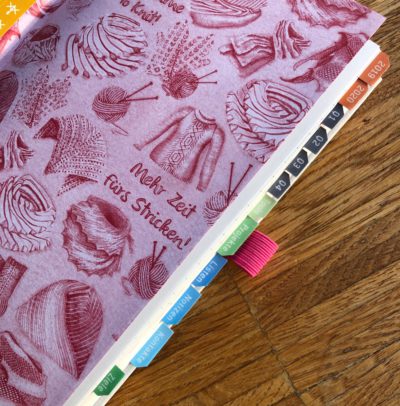
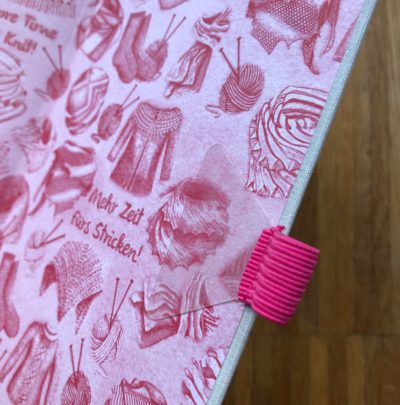
Außerdem habe ich wieder eine Stiftschlaufe eingeklebt – nicht wie in den vergangenen Jahren von Leuchtturm, sondern unsere eigenen. Die sind nicht ganz so eng und passen farblich auch prima zum Planer:
Zusätzlich wollte ich im kommenden Jahr auch die weekview-Froschtasche ausprobieren: Eine Papiertasche zum Einkleben hinten in den Planer, für Zettel und Gedöns (die habe ich freundlicherweise von den weekview-Leuten geschenkt bekommen). Sie ist leider nicht so hübsch wie unser bezauberndes Nachsatzpapier, aber praktisch. Bei weekview bekommt man sie hier (in Kombination mit einer schwarzen Stiftschlaufe).
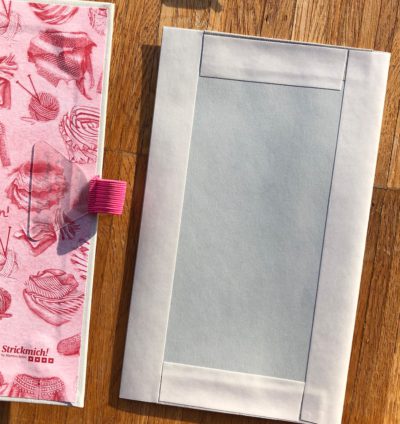
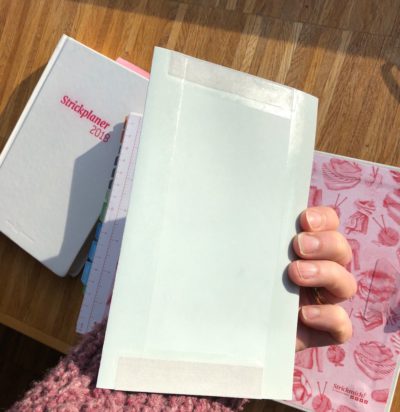
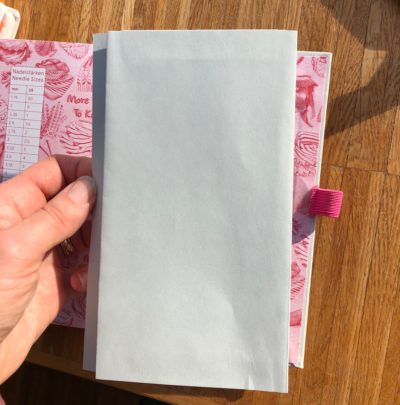
Die Tasche ist fertig gefaltet und mit doppelseitigem Klebeband präpariert, das man nur noch abziehen muss. Dann braucht man eine ruhige Hand, und die Tasche klebt passend hinten im Strickplaner (das ist aber viel einfacher als z. B. eine Schutzfolie aufs Handydisplay aufzubringen!). In diesem Jahr waren wir so schlau, die Nadelstärkentabelle auf die linke Seite zu drucken – darum bleibt sie auch mit Froschtasche sichtbar und nützlich.
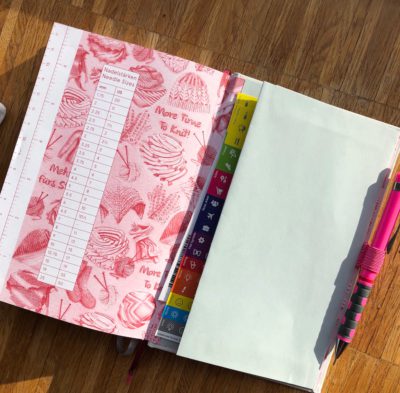
Und weil ich die Tabs so nützlich finde und weiß, dass viele von Euch sich auch eine Froschtasche für den Strickplaner wünschen,
habe ich die Leute von weekview überredet, mir davon welche für eine Verschenk-Aktion zur Verfügung zu stellen. Es gibt zweimal die Froschtasche plus weekview-Sticker und schwarze Stiftschlaufe, und ich habe noch je 3 Bögen Strickmich! Sticker und eine pinke Stiftschlaufe dazu gelegt. Außerdem gibt’s noch 1 Set weekview-Tabs, ebenfalls mit weekview-Stickern und von mir noch Strickmich! Sticker und pinke Stiftschlaufe.
-
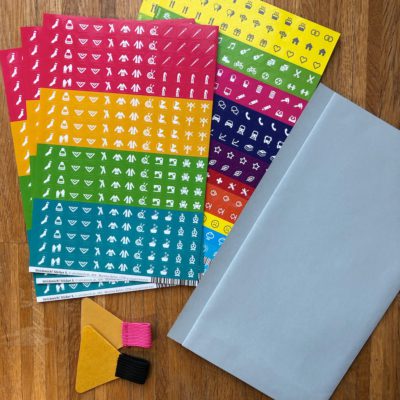
- Compact Nachrüst-Set + Extras
-
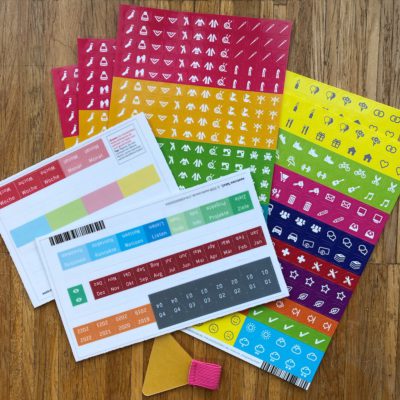
- weekview-Tabs + Extras
Wenn du gewinnen möchtest, schick uns kurz eine Mail an mail (at) strickmich.de und schreib in die Betreffzeile „Giveaway“. Die Gewinnerinnen hören am Freitag von uns!
Die Produkte von weekview wurden mir freundlicherweise kostenlos für diese Verlosung zur Verfügung gestellt.
Die E-mail-Adressen der Teilnehmerinnen werden sofort nach der Verlosung von uns gelöscht und für keine anderen Zwecke als die Verlosung verwendet.
Only a few short weeks and Strickplaner 2019 will be my permanent companion – I always carry my planner with me in my little Bag
(„Side Kick“ by Tom Bihn). This way, I always have all info about appointments and my knitting projects with me, which gives me peace of mind. And if something comes up or I have an idea that needs to be written down, I have everything at hand.
For the second time now we have produced Strickplaner jointly with the calender experts at weekview: The weekly layout is about the same as in the „Compact Note“ planners, but a few important details are different: the colors, our knitting inspiration on the bottom left, the headlines for the to-do-lists. Instead of „goals“ we just have an arrow pointing to the right because I figured that sometimes, you would rather write down a weekly motto or an important event that takes place in that week.
The measurements are the same for both planners – and that’s a big advantage, as all the accessories that weekview offer for their Compact Note will also work in Strickplaner! I have been using the little colorful tabs in my 2018 planner, and I knew I wanted to use them in my 2019 planner as well, as they really help me find things quickly.
So I added them to my 2019 Strickplaner and am very pleased with the result:
I also added a pen loop – not the one by Leuchtturm I used in the past years, but our very own in matching pink. They are a little wider and will accomodate thicker pens and the color looks just great:
As an experiment, I wanted to try the expandable inner pocket that weekview offers: It can be added to the back of the planner and comes with adhesive tape attached. It’s not as pretty as our cute endpapers, but hopefully vey useful! The pocket („Froschtasche“) is available from weekview here.
You need a steady hand to put it in place, but it’s much easier than, say, adding a screen protector to your phone. Voilà!
I just love the tabs and I know many of you would love an interior pocket in their Strickplaners, so I asked weekview for some to give away. The pockets come with black pen loops and weekview stickers, and I added 3 Strickmich! Sticker sheets plus pink pen loops in case you prefer them to match your planner. I have two pocket sets to give away and one with the tabs, stickers and a pink pen loop.
-
- Compact Nachrüst-Set + Extras
-
- weekview-Tabs + Extras
To enter, send an e-mail to mail (at) strickmich.de (using „Giveaway“ as the subject line), and we will draw the winners on Friday. Good luck!
Prizes were gifted by weekview. The email addresses of participants are only used to contact the winners. All addresses will be deleted once the winners are drawn and received their prizes.
Strickmich! Club Anstrick-Event No. 4/2018Strickmich! Club Cast-on Event 4/2018
Ein krönender Abschluss mit einem wunderschönen Garn – lasst uns zusammen das vierte Anstrick-Event des Strickmich! Clubs 2018 feiern:
(Externer Link zu Vimeo)
P. S.: Und nicht vergessen – ab 12 Uhr senden wir live auf Youtube! (Youtube-Link, öffnet in einem neuen Fenster)
It’s a grand finale for Strickmich! Club 2018 with a beautiful yarn and an extraordinarily creative dyer: Let’s celebrate our Cast-on Event!
(external link to vimeo)
P. S.: and don’t forget to tune in live at 12 pm German time, we will be broadcasting on youtube! (youtube link, will open in a new window)